r a d i o m o v i e s

Harrison’s Chronometer Online

Harrison’s Chronometer – a film for radio by Philip Sheppard

hog

The Asylum from Hogarth's Rake's Progress

Harrison’s Chronometer – to listen to the piece click here:

What is it?

I wrote Harrison’s Chronometer in 1999. It was released as the B-side (if there can be such a thing) and companion piece to The Glass Cathedral (which you can hear here).

Unlike the Cathedral piece, this uses electric cello as well as acoustic, and was my first experiment with the (then) new instrument that I’d had made in Seattle. It seems a naive piece in some ways, but it was the first time I’d played with the idea of making films for the radio.

The escapist in me loves the thought of drawing impossible spaces & creating utopian places through sound alone – and, of course, it’s impossible to get near to such a thing… But, it always gives me a kick to have a go…

Original Sleeve notes

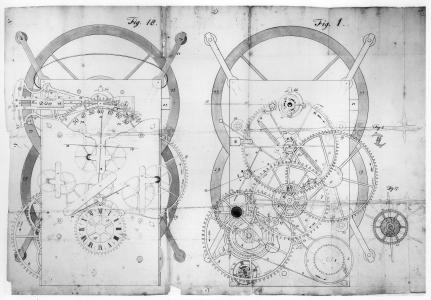
Harrison’s Chronometer is a soundscape depicting a voyage to Lisbon which carried H-1 on its test voyage. Lines of Longitude enmesh the creaking ship and its mechanical cargo locked in the cabin below.

The piece was recorded entirely with an electric cello conceived, designed and built by Eric Jensen in Seattle.

In 1737, John Harrison, a self-trained clockmaker, completed the construction of ‘H-1′, a chronometer designed for sea voyages to determine accurate longitude. Previous attempts to win the £20,000 prize for a foolproof system had attracted inventors, con artists and lunatics. Hogarth portrayed such an obsessive in The Rakes Progress scribbling a solution on the asylum wall.

Hogarth described the timekeeper as ‘one of the most exquisite movements ever made’. Harrison’s timepieces are beautifully displayed at the National Maritime Museum in Greenwich.chronometer3

Gramophone Review

Maybe the programmatic nature of the venture also helps Sheppard to avoid conventional pitfalls. ‘Harrison’s Chronometer’ is a soundscape of a voyage to Lisbon; The Glass cathedral depicts ‘an impossible space’ and sent me back to my LP collection to compare Bryars’s ‘Sinking of the Titanic’ on Obscure.

Like that piece, ‘The Glass Cathedral’ always avoids narcosis, whilst dealing with drones and generally slow changes (except once or twice when Sheppard dumps a huge string section right in your lap after a lull). He’s very committed to improvisation, but I’m not sure how much it could figure in a piece involving 44 cello overdubs. Whatever the case, it works beautifully.

‘Harrison’s Chronometer’ uses a wider vocabulary, drawing on creaks and what sounds like whalesong. It’s gripping music – much more than a soundtrack for an imaginary movie – and it reclaims for string players those long drones and chords that ‘ambient’ musicians couldn’t function without.

1 Comment

1 response so far ↓

Leave a Comment